Are you on drugs?

When you’ve lived a life not putting any boundaries in place, when you begin to, the people around you can be taken back by your sudden interest in your own wellbeing, especially if those people are benefitting from your lack of boundaries.

The first significant boundary I remember attempting to put in place was when I was in my late teens. I was working full time at a law firm and studying part time for my police station accreditation, so all-in-all I was out of the house for 12 hours most days. This day, I had been out of the house from 6am until 9pm. After an emotionally draining few hours at the police station after my 9-5, I rolled into the house ready to grab some food, have a bath, and chill. But going home was never that simple, for as long as I can remember I was always ready to embrace the unexpected. I never knew what I would be going home to, and what mess had already unfolded in my absence.
A quick hello to my dad sitting in the outhouse, where he spent 99% of his time. My brother, gaming, staying out of the way. I headed upstairs, put a bath on, then headed back downstairs to put a load of my washing on. The washer was already on with about 10 minutes left on the cycle, so I just left my pile of clothes in front of the washer ready to swap them out when the wash was done. Well, that was the plan.
A few minutes later my dad's drunken bellow came pounding up the stairs.
‘Move your shit’
Erm, what? He can’t be talking to me, right? I started to head down the stairs, I only made it about halfway down until we locked eyes and there, he was, stood in the corridor with my pile of clothes in his hands. Angry, as always, drunk, as always. He threw them up into the air, and kicked them. Scattering onto the wooden floorboards, falling like confetti, he repeated, ‘Move your shit’.
I can’t recall the exact words I used; they were along the lines of ‘What's wrong? Was your tea not made for you coming home from work? Is the housework not done? Was your bath not run for you?’. Rhetorical questions. I continued, standing up for myself, and let him know that this treatment isn't something I will put up with anymore. My chaotic and emotional attempt at trying to put a boundary in place.
His reply, ‘Are you on drugs?’
The word ‘boundary’ wasn’t even in my vocabulary until I started therapy, and self-help work in my mid-twenties. It’s not something that I was educated on growing up, so heading into early adulthood, I still didn’t even know what a boundary was.
From a psychological standpoint, a boundary is a line or limit you create between yourself and other people. They allow you to define what is acceptable and healthy for you. The boundaries you communicate and maintain can protect you both physically and psychologically.
But how do you put your own wellbeing as a priority when you are a chronic people pleaser with a fear of rejection? That’s what I had to tackle. I tried to have boundaries, subconsciously, but they were repeatedly disrespected and mishandled by other people, including myself. You cannot control how someone else reacts to your boundaries, but what you can control is how YOU respect them. I used to treat my boundaries as weak, pliable and easily broken. Driven by fear of conflict, and a deep need for external approval, I sacrificed my own needs to keep others happy. A genuine fear of the word ‘no’. Because no means I’m not doing what they want, that I will be abandoned. If I meet their unreasonable demands then they’ll stay? Right?
The first step was hitting rock bottom. Not a requirement for most people to start putting boundaries in place, of course, but for me, it was. I’d spent so long doing what other people wanted to do, I came to the realisation that I had absolutely no idea who I was, truly. To rediscover myself, I had to strip away all the distractions, and sit with myself, bare.

I started to face my fear, saying no. That was my whole answer. No. I worked so hard to hold back from giving every justification I could conjure as to why I didn't want to do what someone was asking. Wanna go for drinks? No. Can I come over? No. Send me a photo of your tits? No. Sounds harsh, doesn't it? Almost confrontational. To not provide someone with a reason. In context, justification is fine and natural, but it’s important to note that you’re never actually required to provide that to people. Revolutionary, I know.
So, how do you even discover your own boundaries? Start getting to know yourself, dig deep. Journal. Write about the way that you expect to be treated by others. Meditate and visualise someone respecting you, feel the warmth of validation and safety it provides when your needs are considered, what are those needs?
Journalling prompts to help identify your boundaries:
What makes me uncomfortable?
What specific behaviour triggers me?
What are my deal-breakers?
What are my core values?
Once you’ve established your boundaries, show up for yourself and communicate. Calmly and clearly. You can’t be mad at someone not adhering to a boundary you haven't communicated. Find power in your own voice, and don't be afraid to be heard. Be consistent, and rigid. Compromise can happen, for example, if a boundary for you is that you don’t like physical touch when going to sleep, but your partner does. The negotiated boundary could be that you will have some physical touch before bed, but when it’s time to sleep you don't want to be touched. Just make sure you’re not negotiating boundaries that are firm, it’s better to respect yourself and be alone, than be in the company of someone who doesn't.
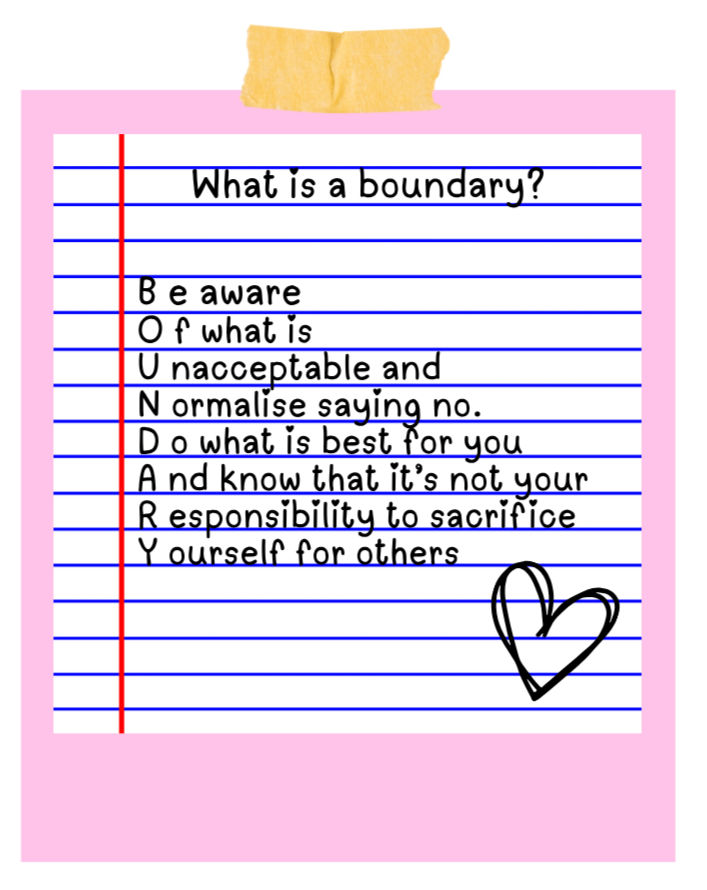
As an empath, boundaries are our armour. If someone comes to you with something they’re dealing with but you’re already at full capacity, let them know. I’m not in a place to help you right now, I’m sorry. As simple as that. We can’t show up for others at the cost of neglecting ourselves. The only person who is with you from the minute you are born until the minute we die, is you. So, be your own no.1 advocate. There's no shame in that, no judgement, no stigma. We should absolutely be putting ourselves first, always.
One boundary that I live by now, which I implore anyone to adopt. Is stop being so fucking available. I don’t reply to messages right away, I don’t answer the phone immediately. A boundary with my time, and my energy. I will reply when I have the capacity, I’ll call you back when I’ve got space to talk, that might be minutes after, or hours, or even days.
I know that some people may disagree with this because as a society, the norm is that we are chronically online. God forbid I’m reading a book, or painting something, or I'm balls deep into giving my cat a performance of the whole Hamilton soundtrack. Or I’m dealing with some personal stuff, and I need to focus my energy on myself right now. When you stop expecting yourself to be available, you stop resenting other people for not being available too. It works both ways. Your time is your own, so own it. Protecting your energy isn’t selfish, its self-respect.
If someone tries to make you feel guilty, or question you for having boundaries, respectfully, they have no place in your life. You respect your own boundaries, and therefore, you will continue to disappoint them.
When you become secure in your boundaries, you open a whole new way of existing. That guilt you used to feel when saying no to someone, and the urge to overexplain, isn't there anymore. You stop expecting people to ‘just know’ what you're feeling, because you’re telling them. You stand strong, even with push back. You take time to check in with yourself before committing to something. You are in tune with your body and what it needs from you. You stop letting pressure and expectations drive you to burnout. You come to a blissful state of knowing that your well-being matters just as much as anyone else's.
Something I don't see spoken about often is boundaries towards yourself. When working on ourselves, boundaries are such a powerful tool to stay dedicated to growth. Internal boundaries will often manifest as affirmations. After all, boundaries are there to make you feel happy, and safe.
Some examples of these are:
I will not talk to myself negatively
I will allow myself to feel my emotions without judgement
I will consistently make time for self-care
I will only commit to one social dedication per week
I will limit my screen time
I will compliment myself every day
I will stick to my budget this month
I will accomplish my goals and not allow negative self-talk to hold me back

Try it, write your boundaries down. Put them on post it notes and dot them around your space, the fridge, your bathroom mirror, the side of your bed. Dedicate yourself, to yourself. No matter how unusual or unorthodox your boundaries are, they are yours, and they are important. Not only that, but they also deserve every ounce of advocacy and respect. If you truly want to live an authentic life, then you need to begin to make peace with disappointing others. It’s not an easy journey, it will take time and setbacks and readjustments, but it is an essential process if you want your life to reflect your deepest desires, values, and needs.
Strong people don't have attitudes or ego; they have boundaries and self-respect.

Comments